The best touring boots, ranked by how far the cuff actually rotates
The best touring boot for most committed backcountry skiers is the Scarpa 4-Quattro GT at under $1,000, built from the touring side with a wide cuff rotation and tech fittings rather than a resort boot with a walk mode bolted on. Cuff rotation, not stiffness, is the specification that decides a touring boot: it ranges from about 40 degrees on a heavy freeride touring boot to over 70 on a fast-and-light race boot.
The best dedicated touring boot for most committed backcountry skiers is the Scarpa 4-Quattro GT at under $1,000, because it is engineered from the touring side of the equation rather than the resort side, and the difference shows up in the cuff, which actually rotates rather than merely unlocking. If you are adding occasional touring to a resort habit, the Fischer Ranger HV 120 DYN at under $1,000 skis the resort properly on the days you are not touring. For long link-ups and ski mountaineering, the Scarpa F1 LT at under $1,000 weighs around a kilogram a boot.
A touring boot is judged on cuff rotation first and stiffness second, which is the exact reverse of how an alpine boot is judged, and it is the clearest example on this site of advice that inverts once you start walking uphill on your own equipment. Every feature that makes a boot ski better downhill, more overlap in the shell, a stiffer spine, additional buckles, takes some of that rotation away, so the honest question before buying is what fraction of your days are actually spent climbing.
<!-- gift-guides-xlink -->What cuff rotation actually buys you
| Boot | Cuff rotation | Best for |
|---|---|---|
| Fischer Ranger HV 120 DYN | Limited, resort-first | Fifty-fifty use, skis the resort well |
| Scarpa 4-Quattro GT | Wide, freeride touring | Touring who also skis the descent hard |
| Scarpa Maestrale RS | About 60 degrees | Long days, stiff enough to drive a big ski |
| Scarpa F1 LT | Very wide, near free-swinging | Ski mountaineering, long link-ups |
On a three thousand foot climb the difference between the low end and the high end of this range is felt in the hip flexors inside the first hour, and it compounds over a full day. A boot with a genuinely wide range of motion lets the leg swing closer to a natural walking stride, while a boot with a narrow range forces a shorter, stiffer step that tires the hip flexors and the lower back well before the legs themselves are the limiting factor.
The picks, at three budgets
Beginner tier here is the fifty-fifty answer: a stiff resort boot with tech fittings bolted onto a genuinely competent alpine shell, which is the correct first purchase for someone touring occasionally. Intermediate and expert tiers are dedicated touring boots, where the trade of downhill damping for uphill range gets more pronounced as the weight comes down.
Touring boot picks

Fischer Ranger HV 120 DYN Mens Boots, 29.5 mondo
- Flex:
- 120
- Last:
- High volume
- Inserts:
- Tech fittings
A stiff resort boot that happens to have tech fittings and a walk mode, which is the right first touring boot for almost everyone: it skis the resort properly on the days you are not touring, so it is one purchase rather than two.
Best for: A resort skier adding occasional touring, on a fifty-fifty setup.
What it costs you: Heavy for a real touring boot and a limited range of cuff motion. On a long climb you will feel both, and once you tour twenty days a year you will want a dedicated boot.
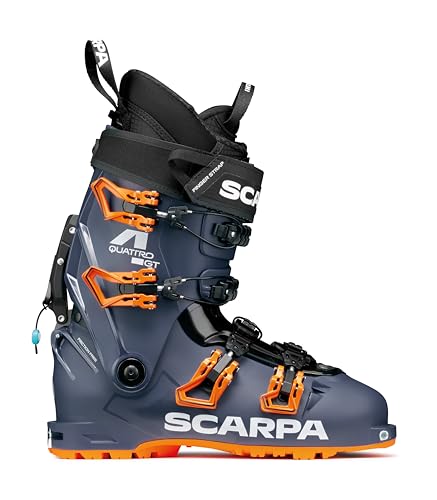
Scarpa 4-Quattro GT Ski Boots, size 29
- Type:
- Freeride touring
- Cuff rotation:
- Wide, walk mode
- Sole:
- Rockered, tech fittings
A boot built from the touring side rather than the resort side, and the difference is the cuff: it actually rotates, which is what stops a long climb feeling like walking in a cast.
Best for: A tourer who also skis the descent hard, on a wide touring ski.
What it costs you: Not as damp as a dedicated alpine boot on hard resort snow, and it costs more.

Scarpa Maestrale RS Ski Boots, size 29
- Type:
- Touring, stiff
- Cuff rotation:
- About 60 degrees
- Sole:
- Tech fittings
The reference point in the category for well over a decade. Stiff enough to drive a big ski and light enough for genuinely long days, and the cuff rotation is the number that makes a fifteen mile tour bearable.
Best for: A dedicated tourer doing long days who skis the descent properly.
What it costs you: Expensive, and its fit is famously specific. This is a boot to have fitted, not to order blind.

Scarpa F1 LT Ski Boots, size 28
- Type:
- Fast and light touring
- Weight:
- Around 1,000 g per boot
- Cuff rotation:
- Very wide
Around a kilogram a boot, with a cuff that swings almost freely in walk mode. On a long link-up the difference against a freeride touring boot is measured in hours, not minutes.
Best for: Ski mountaineering, big vertical days, and people who tour to climb.
What it costs you: Say it plainly: this is not a boot for skiing hard. A light carbon cuff on a wide ski in bad snow gives up a lot, and most people are better served by the Maestrale.
Specifications are the manufacturer's published figures, not measurements we took. Sizes, prices and stock change constantly, so confirm on the retailer page before buying. We earn commissions from Backcountry and from qualifying Amazon purchases, and every link on this page is one or the other. Where a Backcountry button reads "shop the category" it opens a search for that category rather than that exact model, so it finds comparable gear alongside it.
How we chose
We compared published cuff rotation figures, per-boot weight, liner construction and tech-fitting compatibility across the range, then read verified owner reviews for the details that do not appear on a spec sheet: whether a walk mode actually locks solidly for the descent, and how a shell holds up to repeated cold-weather flexing over a season.
We did not tour in these boots ourselves, and we never will. Boot fit is individual to your foot shape and your cuff, and cuff rotation figures published by manufacturers are measured under standardised lab conditions that do not perfectly predict how a specific boot feels on a specific person's stride. What we can honestly do is compare what makers publish and be direct that a touring boot, more than almost any other item on this site, benefits from being fitted in person before a long tour rather than ordered blind.
Fifty-fifty or dedicated: the honest question
A fifty-fifty boot is heavier and its cuff barely rotates compared with a dedicated touring boot, and that trade-off is entirely reasonable for someone who tours ten days a season and skis the resort the rest of the time. It is one purchase instead of two, and it removes the question of which boot to grab on a given morning. Once someone is touring twenty or more days a season, the dedicated boot becomes the upgrade felt on every single climb, not just the long ones, because the weight and the rotation limit are paid for continuously rather than occasionally.
There is no wrong answer between the two, only a mismatch: buying a fast-and-light boot like the F1 LT as a first touring boot is a common and expensive mistake, because the descent performance it gives up is a real cost paid on every single run, while the weight it saves only pays off on genuinely big vertical days that a beginner tourer is not yet doing.
Buying tips
- Have it fitted, not ordered blind. Touring boot fit is famously brand specific, and a shell that fits perfectly in one brand can be wrong in another at the same stated size.
- Confirm tech fitting compatibility with your actual binding. Most current boots and bindings share a compatible standard, but tolerances vary and a shop can check the fit in under a minute.
- Check boot sole length against your binding's adjustment range. A binding has to be set to your boot's specific sole length in millimetres, printed on the boot heel, and a change of boot requires re-checking that setting.
- Buy the boot before the ski if you are choosing between them. A boot that does not fit ruins every day regardless of what is underfoot. A ski is a much smaller compromise.
- Do not buy a race boot as a first touring boot. The lightest boots give up real downhill performance for weight savings that only pay off on the biggest days, which a beginner tourer is not yet doing.
Where touring boots fit in the whole setup
Boots are the item worth prioritising over the ski itself in a touring setup, same as on the resort side. The first backcountry touring setup puts the fifty-fifty Fischer Ranger on the list alongside the avalanche kit and the course that has to come first, and the committed touring setup steps up to the 4-Quattro once you are touring more than the resort. For the binding half of the pairing, see the touring binding roundup, and for the ski, the best touring skis compared by weight and waist.
The boot at the top of this shelf
The Scarpa Maestrale RS at under $1,000 sits above everything ranked here and has been the reference point in the category for well over a decade, with about sixty degrees of published cuff rotation and enough stiffness to drive a wide ski. Its page goes through what that price actually buys, why the fit is the thing most likely to be got wrong when it is ordered online rather than fitted, and why published cuff rotation figures are a rough ranking rather than a measurement you will feel exactly.
Frequently asked questions
What is cuff rotation and why does it matter more than stiffness?
Cuff rotation is how far the upper shell of the boot swings backward and forward when the walk mode is unlocked, typically measured in degrees. A boot with forty degrees of rotation drags at the hip on every stride of a long climb, while one with sixty or seventy degrees moves closer to a natural walking gait. Stiffness governs how the boot skis on the way down, but rotation governs every single step on the way up, and a climb is usually the longer half of a tour.
Can I just tour in my resort ski boots?
Only if they have tech fittings, the small metal inserts at the toe and heel that a tech binding pin clamps into, and even then only occasionally. A resort boot with tech fittings, like the Fischer Ranger HV 120 DYN on this page, is a genuinely reasonable fifty-fifty choice for someone touring a handful of days a season. A resort boot with no tech fittings cannot be mounted into any tech binding at all, no matter how good the walk mode looks.
Do touring boots ski as well as alpine boots at the resort?
Close, but not identically. A touring boot trades some downhill damping for climbing range and lower weight, which is felt most on hard, fast resort snow rather than in soft conditions. A stiff touring boot such as the Scarpa Maestrale RS skis a resort competently. A fast-and-light boot such as the Scarpa F1 LT is genuinely compromised on hard snow at speed and is built for the climb, not the groomer.
How much lighter is a touring boot than an alpine boot?
A stiff alpine boot typically weighs somewhere around 1,800 to 2,200 grams per boot. A dedicated touring boot at the fast-and-light end can weigh close to 1,000 grams per boot, roughly half. On a climb, that weight is lifted and swung with every single stride for thousands of vertical feet, which is why touring boot weight is felt far more acutely than the same weight difference would be in a stationary object.
What are tech fittings and are they all compatible?
Tech fittings are metal inserts moulded into the toe and heel of a touring boot sole that a tech binding pin engages. Most current touring boots and bindings use a compatible standard, but fit tolerances vary between brands and it is worth confirming compatibility with the specific binding before buying, especially for older or minimalist race bindings. A shop can check this in under a minute with the actual boot and binding side by side.
Should a beginner tourer buy a dedicated touring boot?
Usually not as a first purchase. A fifty-fifty boot with tech fittings, like the Fischer Ranger on this page, lets a new tourer ski the resort on non-touring days while still being able to tour, which is one purchase instead of two. A dedicated touring boot with a very wide range of motion is the upgrade to make once you know you are touring more than ten or fifteen days a season, not before.
How we choose: we compare published manufacturer specifications, published certification standards and verified owner reviews across retailers. We do not test equipment in person, and every figure quoted here is the manufacturer's published number unless we say otherwise. This is researched buying guidance and not professional instruction: binding release values are set by a certified technician on a calibrated jig, and avalanche terrain requires formal training and a current regional forecast that no article can replace.