The best ski boots, sorted by last width and flex
The best resort ski boot for most intermediate to advanced skiers is the Atomic Hawx Prime 100 at under $500, a 100 flex on a 100 mm medium last with a fully heat mouldable shell. Last width, not flex or brand, is the specification to shop on first: 97 to 98 mm is narrow, 99 to 101 mm is medium, and 102 to 104 mm is wide, and a foot in the wrong last is never fixed by buckling harder.
The best resort ski boot for most intermediate to advanced skiers is the Atomic Hawx Prime 100 at under $500, because a 100 flex on a 100 mm medium last sits at the exact centre of the market, which is a genuine advantage rather than a marketing line, since it fits the largest number of feet and suits the largest number of skiers. If your foot is wider, the Hawx Magna 100 at under $500 is the same boot on a 102 mm last. If you are just getting started, the Nordica Cruise at under $250 is a soft, wide comfort boot built to be stood in all day.
The boot is the only piece of ski equipment you are physically attached to, and it is the single piece that decides whether a day is enjoyable or a fight. Two numbers govern it, and neither of them is the brand printed on the cuff: last width, which is fit, and flex index, which is stiffness. Get the first one wrong and no amount of buckling fixes it. Get the second one wrong and you either cannot bend the boot or the boot folds under you.
What last width actually means, and why it lies less than flex does
Last is the forefoot width of the shell in millimetres, measured at a reference size, and it is fixed by the mould the boot was built on.
| Last width | Fit | Who it suits |
|---|---|---|
| 97 to 98 mm | Narrow | A low-volume foot and a skier who wants the most direct feel available. Painful on a wide foot no matter how good the bootfitter is. |
| 99 to 101 mm | Medium | The default, and the right starting point for most feet. Almost every performance boot is offered in a 100 mm last. |
| 102 to 104 mm | Wide | A wide forefoot, a high instep, or anyone who has spent years unbuckling on the chairlift. Comfort is what makes you ski more. |
A bootfitter can punch a shell out a few millimetres in one spot for a bunion or a bony ankle, but they cannot change the fundamental width of the last across the whole forefoot. That makes last width the specification to shop on first, before flex, before brand, before colour. Flex index, by contrast, is unstandardised between manufacturers, so a 100 flex from one brand can feel like a 90 or a 110 from another. Treat flex as a ranking within a brand rather than a portable number.
| Flex range | Suits | Note |
|---|---|---|
| 50 to 70 | Beginner | Soft enough to stand in comfortably at the end of the day, and soft enough to fold under a strong skier. |
| 70 to 90 | Beginner to intermediate | The band most rental and comfort boots sit in. Forgiving of a lazy stance. |
| 90 to 110 | Intermediate to advanced | Where most recreational skiers should be buying, and where a boot starts transmitting what the ski is doing. |
| 110 to 130 | Advanced to expert | Stiff. Rewards a skier who drives the front of the boot and punishes one who does not. |
| 130 and up | Expert and race | Almost nobody outside racing needs this. A boot too stiff to flex in the cold is a boot you cannot steer. |
The picks, at three budgets
Beginner tier here is about comfort and a wide, forgiving last, because a new skier's problem is standing in the boot all day, not driving a stiff flex. Intermediate tier is the buy-once range, where a heat mouldable shell gives a bootfitter real room to refine the fit. Expert tier is a genuinely stiff boot on a wide last, a combination the market barely offers, since most stiff boots are built on narrow 98 to 100 mm shells and leave a wide-footed advanced skier choosing between pain and vagueness.
Ski boot picks

Nordica The Cruise Mens All-Mountain Boots, 31.5 mondo
- Flex:
- About 70
- Last:
- Wide, comfort fit
- Size:
- 31.5 mondo
A soft flex and a generous last. This is the boot for someone whose first four ski days were ruined by rental boots, and comfort is not a compromise for a new skier: a boot you can stand in is a boot you will ski in all day.
Best for: A first pair, a wide foot, and green to blue terrain.
What it costs you: Too soft to drive a stiff ski, and it will feel vague as soon as you start skiing quickly. Note the size: boots are sold per size and this listing is one shell.
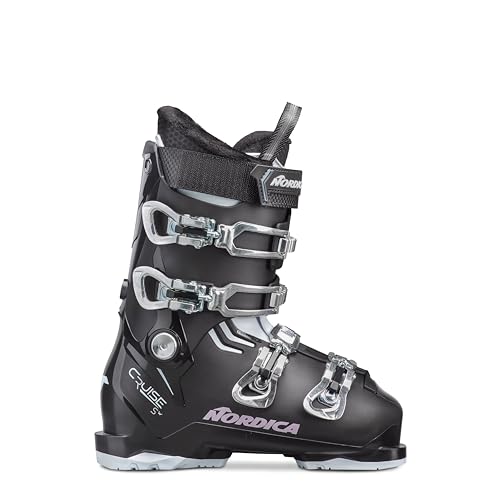
Nordica Cruise S W Womens All-Mountain Boots, 24.5 mondo
- Flex:
- About 65
- Last:
- Wide, comfort fit
- Size:
- 24.5 mondo
A lower cuff height and a softer flex, which are the two changes that genuinely matter in a womens boot and are not marketing. A cuff that is too tall bruises the shin and stops the skier bending the boot at all.
Best for: A newer skier with a wide foot, or anyone who has been fighting a shin bang.
What it costs you: Soft. It will not hold up under an advanced skier.

Rossignol Kelia 50 Womens Ski Boots
- Flex:
- 50
- Last:
- 104 mm, wide
- Level:
- Beginner
A very soft flex and a 104 mm last, which together make the easiest boot on this page to get into and to stand in. For a skier still learning, that is worth more than any performance claim.
Best for: A genuine beginner, and a wide or high-volume foot.
What it costs you: A 50 flex is the softest end of the market. Fast skiing will overwhelm it immediately.

Atomic Hawx Prime 100 Mens Ski Boots, 28/28.5 mondo
- Flex:
- 100
- Last:
- 100 mm, medium
- Shell:
- Heat mouldable
A 100 flex on a 100 mm last is the exact centre of the ski boot market, and it is the centre for a good reason: it fits the most feet and suits the most skiers. The shell is fully heat mouldable, so a bootfitter has real room to work.
Best for: An intermediate to advanced skier with an average-width foot, buying a boot to keep.
What it costs you: A 100 mm last is too narrow for a genuinely wide foot and no amount of punching fixes the wrong last.

Atomic Hawx Magna 100 Mens Ski Boots, 28/28.5 mondo
- Flex:
- 100
- Last:
- 102 mm, wide
- Shell:
- Heat mouldable
The same boot on a 102 mm last. This is the entry that solves the most real problems on this page, because a wide-footed skier is usually offered either a wide comfort boot with no performance or a performance boot that hurts, and this is neither.
Best for: A wide or high-volume foot that still wants a 100 flex.
What it costs you: A wider last gives up a little precision. A narrow foot will swim in it.

Head Edge 65 W HV Womens Ski Boots, 25.5 mondo
- Flex:
- 65
- Last:
- High volume
- Size:
- 25.5 mondo
A high-volume shell, which is the specification a lot of women get pushed past because the marketing assumes a narrow foot. Volume and width are not the same thing, and a high instep needs volume.
Best for: A womens fit with a high instep or a wide forefoot, skiing blues.
What it costs you: A 65 flex sits between beginner and intermediate. Strong skiers will want more.

Nordica Sportmachine 3 80 Mens Ski Boots, 29.5 mondo
- Flex:
- 80
- Last:
- 102 mm
- Liner:
- Heat mouldable
An 80 flex on a 102 mm last with a mouldable liner. That combination is the honest sweet spot for a skier who is past beginner and not yet aggressive, and it costs meaningfully less than a 100 flex boot.
Best for: A progressing intermediate who does not want to buy twice but is not skiing hard yet.
What it costs you: You will feel the flex limit if you keep improving. That is the trade for the price.

Atomic Hawx Magna 110 S Mens Ski Boots, 27/27.5 mondo
- Flex:
- 110
- Last:
- 102 mm, wide
- Shell:
- Heat mouldable
A genuinely stiff boot on a wide last, which is a combination the market barely offers. Most 110 and above boots are built on 98 to 100 mm shells, and a wide-footed advanced skier is usually left choosing between pain and vagueness.
Best for: An advanced skier with a wide foot who skis fast.
What it costs you: A 110 flex in a cold parking lot is genuinely hard to get into, and if you cannot bend a boot you cannot steer with it. Do not buy stiffness you cannot use.
Specifications are the manufacturer's published figures, not measurements we took. Sizes, prices and stock change constantly, so confirm on the retailer page before buying. We earn commissions from Backcountry and from qualifying Amazon purchases, and every link on this page is one or the other. Where a Backcountry button reads "shop the category" it opens a search for that category rather than that exact model, so it finds comparable gear alongside it.
How we chose
We compared published last widths, flex indices within each brand's own range, liner construction and shell mouldability across every boot here, then read verified owner reviews across retailers for the details a spec sheet omits: instep volume, cuff height on shorter shins, and how a shell holds up to repeated heat moulding.
We did not fit these boots to a human foot in person, and we never will. Boot fit is the most individual measurement in skiing, governed by your specific foot shape, instep height, ankle bone position and calf shape, none of which a review from any site can know in advance. What we can honestly do is compare what manufacturers publish about last, flex and construction, and be direct that a boot bought without trying it on is always a bigger gamble than a helmet or a jacket bought the same way.
How to tell if a boot actually fits
A correctly sized ski boot shell feels tight, almost uncomfortably so, when you first stand in it with no socks bunching. That is normal and expected: the liner packs out and the shell relaxes slightly with wear, and a boot that feels roomy on day one in the shop will feel genuinely loose by day thirty. Toes should lightly brush the end of the liner when standing straight and pull back off it when you flex forward into a skiing stance. If toes are curled or jammed the whole time, the boot is too short. If a foot slides fore and aft inside the shell, it is too long or too wide.
Buckle pressure should close with the buckles roughly in the middle of their travel range, not at the very last notch. A buckle that has to be cranked to its limit to close means the shell is already too small for the foot, and there is no adjustment range left for the liner to pack out into. Conversely, a buckle that barely needs to close at all means there is too much room and the foot will move.
Buying tips
- Measure both feet, standing, at the end of the day. Feet swell over a day and are rarely identical in length. Size to the larger foot and fit the smaller one with an extra insole if needed.
- Do not buy a size up for comfort. A boot with extra internal room lets the foot move, which is both less precise and, counterintuitively, colder, since a loose boot allows the kind of movement that restricts circulation more than a snug one does.
- A heat mouldable shell is worth the extra cost if you can get it fitted. Without a bootfitter to actually mould it, the feature does nothing. With one, it is the difference between a good fit and a great one.
- Buy a footbed at the same time. Stock insoles are flat foam and let the foot spread inside the shell, which causes a large share of the pinching people blame on the boot itself. The accessories roundup covers supportive footbeds under forty dollars.
- Note that boots are sold per size. A listing photographed in one mondopoint size is that size only. Confirm the size in the listing matches your measured foot before buying.
Where boots fit in the whole setup
Boots are the purchase to prioritise over every other item on this site, including the ski itself, and once they fit, the best all-mountain skis roundup compares the resort skis to put under them by waist width and price. The first resort ski setup puts a comfort-first boot on the list at under $250, and the buy-once resort setup steps up to the Hawx Prime above once you know your foot shape and how many days you actually ski. If you are pairing boots with a binding, the binding roundup covers GripWalk compatibility and brake width, and the mondopoint calculator converts your measured foot length into every size scale a shop will quote you.
The stiff wide boot above this ranking
The Atomic Hawx Magna 110 S at under $500 is a combination the market barely offers: a genuinely stiff flex on a 102 mm last, where most boots at 110 and above are built on 98 to 100 mm shells. Its page is equally direct about the catch, which is that a 110 flex in a cold car park is hard to get into and harder to bend, and a boot you cannot flex is a boot you cannot steer with. Wide foot first, flex second.
Frequently asked questions
What is the single most important number when buying a ski boot?
Last width, the forefoot width of the shell in millimetres. It is not adjustable in any meaningful way, unlike flex, which you grow into, or size, which a bootfitter can nudge with punches and grinding. A narrow foot in a wide last swims and loses control; a wide foot in a narrow last is painful within an hour no matter how skilled the fitter is. Get last width right first and everything else is solvable.
Is a stiffer flex always better?
No, and buying more flex than you can bend is one of the most common expensive mistakes in skiing. A boot you cannot flex forward is a boot you cannot steer, because steering a ski happens by pressuring the front of the boot with your shin. A skier who cannot bend a 110 flex boot skis worse in it than in a well-matched 90, regardless of what the number on the cuff suggests about their ability.
Do ski boot flex numbers mean the same thing across brands?
No, and this catches a lot of buyers out. Flex index is not standardised by any regulatory body, so a 100 flex from one manufacturer can feel closer to a 90 or a 110 from another. Treat the number as a ranking within one brand rather than a comparison across brands, and if you are switching brands, try the boot rather than buying to the same number you wore last time.
What does mondopoint mean and why do boots use it instead of shoe sizes?
Mondopoint is simply the length of your foot in centimetres, and it is the one size measurement on a ski boot that is not a marketing translation. US, UK and EU sizes on ski boots are all derived from mondopoint and the conversion is not perfectly consistent between brands, which is why two boots both labelled US size 9 can differ by half a size. Measure your foot length and shop mondopoint first.
Should I buy ski boots online or get fitted in a shop?
Get fitted in a shop whenever the budget allows it, especially for anything above a beginner comfort boot. A bootfitter measures last width, checks for pressure points that only show up under load, and can heat mould a shell to your specific foot. Buying online works well for a boot you already know fits, or for a soft comfort boot where the margin for error is wide. It works badly for a performance boot bought blind.
How often should ski boots be replaced?
The liner packs out and loses roughly ten to fifteen percent of its cushioning within the first fifty days of use, and continues degrading slowly after that, so a boot that felt perfect when new can feel loose within a season or two of regular skiing. The plastic shell lasts much longer, often a decade or more, but buckles, liners and soles wear and are worth inspecting each fall before the first ski day.
How we choose: we compare published manufacturer specifications, published certification standards and verified owner reviews across retailers. We do not test equipment in person, and every figure quoted here is the manufacturer's published number unless we say otherwise. This is researched buying guidance and not professional instruction: binding release values are set by a certified technician on a calibrated jig, and avalanche terrain requires formal training and a current regional forecast that no article can replace.