The best ski poles, resort and touring
For resort skiing a fixed aluminium pole at under $100 is all you need. For touring, buy an adjustable lever-lock pole with a powder basket and an extended foam grip, under $250, because a climb wants the pole short, a sidehill wants each pole a different length, and the descent wants them back at full length.
A ski pole is a stick with a basket on it, and for resort skiing that is genuinely the whole story: the 5th Element aluminium pole at under $100 does everything a lift-served pole needs to do. Touring is where the choice starts to matter, and the answer there is an adjustable lever-lock pole with a powder basket and an extended grip, which is the LEKI Sherpa Lite at under $250. If your days are long and fast, the Helicon Lite at under $250 saves weight where weight is felt most.
Poles are the cheapest hard good in skiing and the one people replace least often, which is reasonable, because a pole that fits and does not fail is a solved problem. What follows is mostly about sizing, which nearly everyone gets slightly wrong, and about the specific things touring asks for that a resort pole cannot provide.
Sizing, in ninety seconds
- Put your ski boots on. A boot adds two to three centimetres of heel height and changes your stance. Sizing a pole in trainers gives you a pole that is slightly too long.
- Turn the pole upside down and grip it under the basket. Hand around the shaft, just below where the basket meets it.
- Stand straight, elbow at your side. Your forearm should be parallel to the floor and your elbow at roughly ninety degrees.
- Adjust from there. Higher hand means the pole is too long. Lower means it is too short. Round to the nearest five centimetre size the pole is sold in.
- Sanity check the arithmetic. Height in inches times 0.68, rounded to the nearest available centimetre size, lands within one size for most people. The pole length calculator does it for you and explains what changes for touring.
Two adjustments to that baseline. Mogul and race skiers often go one size shorter for a faster pole plant. Anyone skiing a lot of deep soft snow sometimes goes one size longer, because the basket sinks and the effective length shortens.
The picks, at three budgets
The ladder is green circle, blue square, black diamond, the same three tiers used across this site. Green is the resort pole. Blue is the adjustable touring pole, in a shorter range and a longer range so you can match your height. Black is the light option for long days.
Ski pole picks
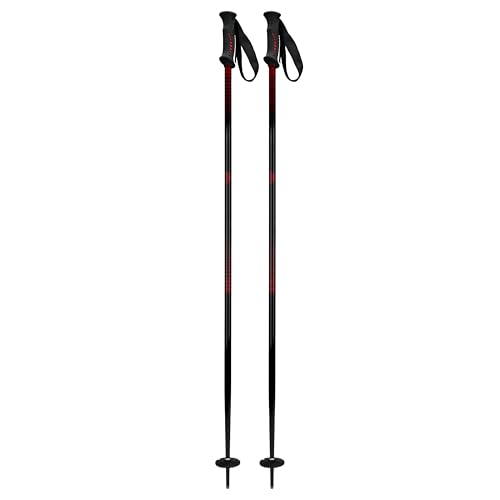
5th Element Shadow Aluminium Ski Poles
- Material:
- Aluminium
- Grip:
- Adjustable strap
- Use:
- Resort
A ski pole is a stick with a basket. Aluminium bends rather than snapping, which is the failure mode you want, and a resort pole spends its life being stepped on in a lift line.
Best for: Resort skiing and a first pair.
What it costs you: Fixed length, and no use for touring where you want the pole shorter on the climb.

LEKI Sherpa Lite Ski Poles, 100 to 135 cm
- Adjust:
- 100 to 135 cm
- Basket:
- Powder basket
- Grip:
- Extended foam
Adjustability is not a luxury on a tour: you want the poles short and the extended grip in hand for a steep skin track, and full length for the descent. An extended foam grip lets you choke down on a sidehill without stopping to adjust.
Best for: Touring, and resort skiers who want one adjustable pair.
What it costs you: Heavier and more failure points than a fixed pole, and a locking mechanism can slip in deep cold.
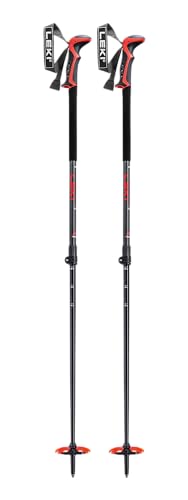
LEKI Haute Route 2 Ski Poles, 110 to 150 cm
- Adjust:
- 110 to 150 cm
- Baskets:
- Interchangeable
- Use:
- Ski touring
A forty centimetre adjustment range covers a flat approach, a steep sidehill and a descent without compromise. Interchangeable baskets matter because a summer basket sinks straight through spring snow.
Best for: Ski touring and traverses with varied terrain.
What it costs you: Long collapsed length compared to a folding pole. Awkward strapped to a small pack.

LEKI Helicon Lite Ski Poles, 110 to 145 cm
- Adjust:
- 110 to 145 cm
- Weight:
- Light aluminium
- Use:
- Fast touring
Weight in a pole is lifted and swung thousands of times an hour, which is why it is felt more than weight anywhere else on a touring setup. This is the light option that is still a serious pole.
Best for: Long tours and skimo-adjacent days.
What it costs you: Lighter shafts are less tolerant of being levered on. Do not use a light pole as a pry bar.
Specifications are the manufacturer's published figures, not measurements we took. Sizes, prices and stock change constantly, so confirm on the retailer page before buying. We earn commissions from Backcountry and from qualifying Amazon purchases, and every link on this page is one or the other. Where a Backcountry button reads "shop the category" it opens a search for that category rather than that exact model, so it finds comparable gear alongside it.
How we chose
We compared published shaft materials, adjustment ranges, locking mechanisms, grip designs, basket compatibility and stated weights across the range, then read verified owner reviews across retailers for the two things a specification cannot show: whether a lock slips under load in deep cold, and whether a grip is usable with a mitten on. We did not test these poles in person. Every figure is the manufacturer's own published number.
What touring asks for that a resort pole does not
| Feature | Why touring needs it |
|---|---|
| Adjustable length | Short for a climb, asymmetric on a sidehill, full length for the descent |
| Lever lock, not twist lock | Operable with a mitten, adjustable when it slips, and visibly closed |
| Extended foam grip | Choke down on a steep traverse without stopping to adjust anything |
| Powder basket | A small basket sinks through spring snow and gives you nothing to push against |
| Low weight | Lifted and swung thousands of times an hour. Felt more than weight anywhere else |
| Straps you can shed | Straps are a known hazard in moving snow. Off before anything consequential |
Aluminium against carbon
Aluminium is the default for good reasons. It is cheap, it is tough, and when it does fail it bends rather than snapping, which usually leaves you with a pole you can still ski out on. That matters more than it sounds, because the most common way a pole is destroyed is being levered on to get out of a hole or a tree well, which is precisely the situation where you need it to hold.
Carbon is lighter and damps vibration better, and on a long tour the weight saving is genuinely felt in the shoulders. Its failure mode is the problem: carbon splinters and goes from fine to completely broken with no intermediate state, and it does this most readily under exactly the side loads you apply when levering. Composite shafts with aluminium lower sections are a common compromise, keeping the tough section where the abuse happens.
Straps: the one safety note on this page
Pole straps are useful at a resort. In avalanche terrain they are a recognised hazard, because a pole caught in moving snow can pull and hold you, and because you cannot get your hands free to swim or to reach an airbag handle with two poles attached to your wrists. The habit worth building is simple: straps off before you drop in, and off for any traverse below a slope that could release.
That is a small piece of a much larger subject. Avalanche gear only works alongside formal training, and no equipment substitutes for an avalanche course or for reading the regional forecast before every tour. The avalanche safety basics and the forecast guide are where to start.
Poles as a rescue and repair tool
A touring pole does several jobs beyond skiing. A pole with a removable basket and a threaded grip can serve as an emergency probe, although a real 280 cm probe is faster, longer and vastly better and there is no argument for substituting. Poles splint a broken binding, brace a sled, check snow depth, and test the surface ahead of you on a bridged creek crossing.
None of that changes the buying decision much, but it does explain why touring poles are built heavier than a pure weight argument would suggest, and why a very light shaft is a poor choice for someone who tours alone or in remote terrain.
Where poles sit in the whole setup
Poles are near the end of the buying order and that is correct: they are cheap, they last, and nothing about them ruins a day the way a badly fitted boot does. The buying order guide puts boots, helmet and lessons first, and the first resort setup prices the whole list including poles with a running total.
For the backcountry, the first touring setup shows where an adjustable pole lands alongside skins, a pack and the safety kit, and the skinning guide explains what you are actually doing with the poles on a climb, which is where the adjustment range earns its money.
Frequently asked questions
How do I work out what length ski pole I need?
Turn the pole upside down, grip it just under the basket and stand up straight in your ski boots. Your forearm should be level with the floor and your elbow at roughly ninety degrees. If your hand is higher than that the pole is too long, and if it is lower the pole is too short. As a starting point before you have a pole in your hand, multiply your height in inches by 0.68 and round to the nearest available size in centimetres. Racers and mogul skiers often go a little shorter for a quicker pole plant, and deep-snow skiers sometimes go a little longer.
Should I buy adjustable poles for touring?
Yes, and it is one of the clearer answers in touring equipment. On a climb you want the poles short, and on a steep sidehill you want the uphill pole shorter still and the downhill pole longer, which no fixed pole can give you. On the descent you want them back at your normal ski length. An adjustable pole with a lever lock covers all three in seconds without taking your gloves off. The trade is weight, more failure points and a locking mechanism that can slip in deep cold, which is why touring poles also come with an extended foam grip so you can choke down without adjusting at all.
Are carbon ski poles worth it?
For touring, sometimes. Weight in a pole is lifted and swung thousands of times an hour on a skin track, so it is felt more per gram than weight almost anywhere else in a setup. Carbon saves real weight and damps vibration nicely. The problem is the failure mode: aluminium bends and can often be straightened enough to finish a day, while carbon splinters and fails completely and without warning, usually the moment you lever on it to get out of a hole. For resort skiing, where poles get stepped on in lift lines and thrown in car boots, aluminium is the sensible answer.
What basket do I need?
A powder basket, which is the larger diameter one, for anything involving soft snow or touring. A small summer or trekking basket sinks straight through spring snow and offers nothing to push against, which turns every pole plant on a climb into a wasted motion. Most touring poles ship with interchangeable baskets and the swap takes a minute with hot water to soften the plastic. Resort poles usually come with a mid-size basket that is fine for groomers and marginal on a powder day, and swapping to a larger one is a cheap upgrade if you ski soft snow.
Lever lock or twist lock?
Lever lock, for winter use, and it is not particularly close. A twist lock relies on an expanding plug inside the shaft, which needs a specific torque to hold and which is difficult to judge through gloves and unreliable when the interior is iced. A lever or clamp lock can be operated with a mitten on, its clamping force can be adjusted with a small screw when it starts to slip, and you can see at a glance whether it is closed. Twist locks are lighter and cleaner looking, which is why they persist, but in cold and wet conditions the external clamp is the more reliable mechanism.
Should I use the pole straps?
At the resort, yes, because a dropped pole on a groomer is an annoyance and the strap gives you something to push against in the pole plant. In avalanche terrain, no. Straps are one of the recognised ways people are pulled and held under in moving snow, and they also make it slow to shed the poles if you need your hands. The habit worth building is straps off before you drop into anything consequential, and off for any traverse below a slope that could release. Some touring poles use breakaway straps for exactly this reason.
How we choose: we compare published manufacturer specifications, published certification standards and verified owner reviews across retailers. We do not test equipment in person, and every figure quoted here is the manufacturer's published number unless we say otherwise. This is researched buying guidance and not professional instruction: binding release values are set by a certified technician on a calibrated jig, and avalanche terrain requires formal training and a current regional forecast that no article can replace.