Season pass vs day tickets
Divide the pass price by the ticket price you would realistically pay and round up: a $900 pass against a $180 window ticket breaks even on day five. Buy the pass in spring when it first goes on sale, since prices commonly rise twenty to thirty per cent by late autumn, and count the days you actually skied last season rather than the ones you planned.
A season pass is not cheaper than day tickets. It is cheaper than a specific number of day tickets, and working out that number is the whole decision. The arithmetic takes ten seconds. The hard part is being honest about how many days you will actually ski, which for most people is fewer than they plan and more than last year.
The breakeven, in one line
Pass price divided by ticket price, rounded up, is your breakeven in days. A nine hundred dollar pass against a one hundred and eighty dollar window ticket breaks even on the fifth day. Everything after that is free skiing, and everything before it is a loss.
| Pass price | Ticket $110 | Ticket $150 | Ticket $190 |
|---|---|---|---|
| $550 | 5 days | 4 days | 3 days |
| $750 | 7 days | 5 days | 4 days |
| $900 | 9 days | 6 days | 5 days |
| $1,200 | 11 days | 8 days | 7 days |
| $1,600 | 15 days | 11 days | 9 days |
The number that moves the answer most is the ticket price, not the pass price, and it is the one people are least careful about. A holiday window ticket and a midweek advance ticket at the same resort can differ by a factor of two, so comparing a pass against the highest ticket price makes every pass look like a bargain. Compare against the tickets you would genuinely buy.
The honest day count
Almost everybody overestimates. The useful discipline is to count last season rather than to plan this one, then adjust for anything that has actually changed: a move closer to the mountain, a new job with different hours, a child who has started skiing, a knee that has not.
Two corrections are worth applying to that number. Weather and life reduce it, because a season always contains a rain week and a work crisis. And owning a pass increases it, because the marginal cost of a day drops to fuel and food, which removes the daily decision about whether the mountain is worth the ticket price. That second effect is genuine and it is the strongest argument for a pass beyond the arithmetic.
What a ski day costs beyond the ticket
- Fuel and vehicle wear. A mountain drive is long, cold and hard on a car, and it is a real per-day cost.
- Parking. Increasingly charged and increasingly expensive at busy resorts, sometimes reserved in advance.
- Food. Resort prices, unless you pack it, which is the easiest saving available on a ski day.
- Equipment amortised. A $1,000 kit over ten days a season for three seasons is $33 a day. Over forty days a season it is $8.
- Lessons. Worth budgeting rather than treating as optional, because they buy more improvement per dollar than any equipment upgrade.
That amortisation line is why the frequent skier gets better value from everything at once. More days lowers the per-day cost of the pass, the gear and the travel simultaneously, which is also why renting against buying crosses over faster than people expect once the day count rises.
The season budget calculator takes all of these together and produces the number that actually matters, which is the total cost of the season and the cost per day it implies.
Single resort against multi-resort products
| Single resort pass | Multi-resort pass | |
|---|---|---|
| Best for | A home mountain within an easy drive | Two or three trips a season to different places |
| Days | Usually unlimited | Often limited per resort, sometimes with blackouts |
| Extras | Parking, lessons, food and rental discounts are usually better | Varies, and often thinner at any individual mountain |
| Risk | A bad snow year at one hill hurts | Spread across regions, which hedges a poor season |
| Hidden cost | None much | Travel. The pass is cheap and the flights are not |
The trap with multi-resort products is comparing the headline price against a local pass and concluding it is better value, when the real cost of using it is dominated by flights, accommodation and time off work. A pass is only cheap if the days it unlocks are days you would otherwise have paid for.
Buy early, and consider the insurance
Pass prices rise in steps from the spring release through the autumn, and the difference between the earliest price and the last one is commonly twenty to thirty per cent. That is a larger discount than almost anything else available in skiing, and it costs you nothing except committing before you know anything about the snow year.
That commitment is the actual product being sold, which is why most passes now offer some form of protection against injury, job loss or a resort closure. It is worth pricing, particularly if you are buying for a family, where a single injury can strand several hundred dollars of unused passes.
When day tickets are the right answer
- Your realistic day count is below the breakeven. Four days against a nine day breakeven is not close, and no argument about flexibility changes that.
- You are new and unsure you will stick with it. Buy tickets and lessons for a first season and a pass for the second, once you know.
- You ski several different mountains casually. Advance tickets at each are often cheaper than a pass that only covers some of them.
- Your schedule is genuinely unpredictable. A pass rewards flexibility of timing, and if you cannot choose your days you cannot use it well.
- You are travelling to ski once. A trip is a ticket purchase, and the money is better spent on advance tickets plus not renting a boot.
The purchase that changes a ski day more than the pass does
Whichever way the pass decision falls, the largest single improvement available to most skiers is owning boots that fit. Rental boots are the leading cause of miserable ski days by a wide margin, they cost forty to sixty dollars a day to rent, and a fitted pair of your own crosses over from rent to buy within about a dozen days.
Ski boots, at three budgets

Nordica The Cruise Mens All-Mountain Boots, 31.5 mondo
- Flex:
- About 70
- Last:
- Wide, comfort fit
- Size:
- 31.5 mondo
A soft flex and a generous last. This is the boot for someone whose first four ski days were ruined by rental boots, and comfort is not a compromise for a new skier: a boot you can stand in is a boot you will ski in all day.
Best for: A first pair, a wide foot, and green to blue terrain.
What it costs you: Too soft to drive a stiff ski, and it will feel vague as soon as you start skiing quickly. Note the size: boots are sold per size and this listing is one shell.
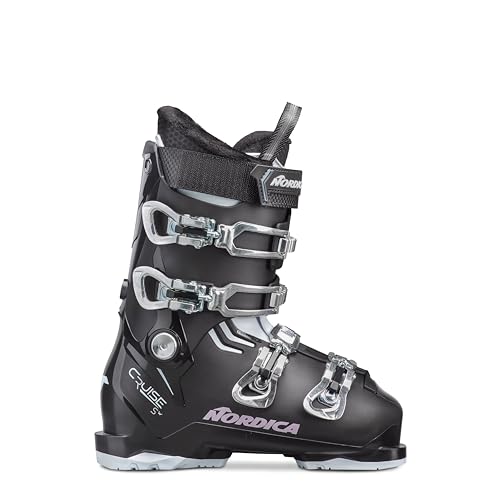
Nordica Cruise S W Womens All-Mountain Boots, 24.5 mondo
- Flex:
- About 65
- Last:
- Wide, comfort fit
- Size:
- 24.5 mondo
A lower cuff height and a softer flex, which are the two changes that genuinely matter in a womens boot and are not marketing. A cuff that is too tall bruises the shin and stops the skier bending the boot at all.
Best for: A newer skier with a wide foot, or anyone who has been fighting a shin bang.
What it costs you: Soft. It will not hold up under an advanced skier.

Rossignol Kelia 50 Womens Ski Boots
- Flex:
- 50
- Last:
- 104 mm, wide
- Level:
- Beginner
A very soft flex and a 104 mm last, which together make the easiest boot on this page to get into and to stand in. For a skier still learning, that is worth more than any performance claim.
Best for: A genuine beginner, and a wide or high-volume foot.
What it costs you: A 50 flex is the softest end of the market. Fast skiing will overwhelm it immediately.

Atomic Hawx Prime 100 Mens Ski Boots, 28/28.5 mondo
- Flex:
- 100
- Last:
- 100 mm, medium
- Shell:
- Heat mouldable
A 100 flex on a 100 mm last is the exact centre of the ski boot market, and it is the centre for a good reason: it fits the most feet and suits the most skiers. The shell is fully heat mouldable, so a bootfitter has real room to work.
Best for: An intermediate to advanced skier with an average-width foot, buying a boot to keep.
What it costs you: A 100 mm last is too narrow for a genuinely wide foot and no amount of punching fixes the wrong last.

Atomic Hawx Magna 100 Mens Ski Boots, 28/28.5 mondo
- Flex:
- 100
- Last:
- 102 mm, wide
- Shell:
- Heat mouldable
The same boot on a 102 mm last. This is the entry that solves the most real problems on this page, because a wide-footed skier is usually offered either a wide comfort boot with no performance or a performance boot that hurts, and this is neither.
Best for: A wide or high-volume foot that still wants a 100 flex.
What it costs you: A wider last gives up a little precision. A narrow foot will swim in it.

Head Edge 65 W HV Womens Ski Boots, 25.5 mondo
- Flex:
- 65
- Last:
- High volume
- Size:
- 25.5 mondo
A high-volume shell, which is the specification a lot of women get pushed past because the marketing assumes a narrow foot. Volume and width are not the same thing, and a high instep needs volume.
Best for: A womens fit with a high instep or a wide forefoot, skiing blues.
What it costs you: A 65 flex sits between beginner and intermediate. Strong skiers will want more.

Nordica Sportmachine 3 80 Mens Ski Boots, 29.5 mondo
- Flex:
- 80
- Last:
- 102 mm
- Liner:
- Heat mouldable
An 80 flex on a 102 mm last with a mouldable liner. That combination is the honest sweet spot for a skier who is past beginner and not yet aggressive, and it costs meaningfully less than a 100 flex boot.
Best for: A progressing intermediate who does not want to buy twice but is not skiing hard yet.
What it costs you: You will feel the flex limit if you keep improving. That is the trade for the price.

Atomic Hawx Magna 110 S Mens Ski Boots, 27/27.5 mondo
- Flex:
- 110
- Last:
- 102 mm, wide
- Shell:
- Heat mouldable
A genuinely stiff boot on a wide last, which is a combination the market barely offers. Most 110 and above boots are built on 98 to 100 mm shells, and a wide-footed advanced skier is usually left choosing between pain and vagueness.
Best for: An advanced skier with a wide foot who skis fast.
What it costs you: A 110 flex in a cold parking lot is genuinely hard to get into, and if you cannot bend a boot you cannot steer with it. Do not buy stiffness you cannot use.
Specifications are the manufacturer's published figures, not measurements we took. Sizes, prices and stock change constantly, so confirm on the retailer page before buying. We earn commissions from Backcountry and from qualifying Amazon purchases, and every link on this page is one or the other. Where a Backcountry button reads "shop the category" it opens a search for that category rather than that exact model, so it finds comparable gear alongside it.
If you are flying to ski rather than driving, a padded rolling bag is the other line worth budgeting, because airline handling breaks tips and tails and a topsheet repair costs more than the bag does.
For the whole picture, the first resort setup prices a complete kit with a running total, and the buying order guide explains why boots and lessons come before skis regardless of how the pass arithmetic lands.
Frequently asked questions
How many days does a season pass need to break even?
Divide the pass price by the walk-up window ticket price and round up. If a pass is $900 and a window ticket is $180, the pass pays for itself on the fifth day. The number most people get wrong is the ticket price, because it varies enormously by day and by how far ahead you buy: a holiday window ticket can be double a midweek advance purchase. Use the price of the tickets you would realistically buy, which for most people is a mix, and remember that a pass also removes the incentive to ski a day you would otherwise skip because the ticket felt too expensive.
Are multi-resort passes better value than a local pass?
They are better value per resort and often worse value per day, and which matters depends on whether you travel. A multi-resort product spreads a moderate price across many mountains with a limited number of days at each, which suits somebody taking two or three trips a season. A single-resort pass usually gives unlimited days at one hill with fewer blackout restrictions and better parking, lesson and food benefits, which suits somebody with a home mountain forty minutes away. Count your realistic days at each destination before comparing headline prices, because the two products are not measuring the same thing.
When is the cheapest time to buy a pass?
As early as it goes on sale, which for the major products is in the spring for the following winter, and the price then rises in steps through the autumn. The saving between the first release price and the late-autumn price is commonly twenty to thirty per cent, which is often larger than any other discount available anywhere in skiing. The catch is that you are committing before you know anything about the snow year, your schedule or your knees, which is exactly why the price is lower. Most passes now sell some form of insurance product against injury or job loss, and it is worth pricing.
Does a pass really change how much you ski?
For most people, substantially, and it is the strongest argument for buying one. Once the pass is paid for, the marginal cost of a ski day is fuel and a sandwich, which removes the daily decision about whether the mountain is worth a hundred and eighty dollars today. That means more short days, more midweek mornings and more willingness to go on a mediocre forecast, which is often when the snow turns out to be good. It also means you ski more days on the same gear, which lowers your cost per day on equipment. The counterpoint is that a pass you do not use is the most expensive ticket you ever bought.
What is the real cost of a ski day beyond the ticket?
Usually as much again as the ticket, and often more. Fuel and vehicle wear for a mountain drive, parking where it is charged, food on the hill at resort prices, and equipment amortised over the number of days you use it. A thousand dollars of gear used ten days a season for three seasons is thirty-three dollars a day, and used forty days a season it is eight. That amortisation is why the frequent skier gets better value from everything, not just the pass, and why buying rather than renting crosses over faster than people expect once the day count rises.
Is it worth buying tickets in advance?
Almost always, and the saving is larger than most skiers realise. Resorts price dynamically now, so a walk-up window ticket is deliberately the most expensive way to ski and can be nearly double an equivalent ticket bought a week or two ahead. If you are certain of your dates, advance purchase is the single easiest saving in skiing. If you are not, the trade is between a cheaper ticket you cannot change and a flexible one that costs more, and for a mountain three hours away the flexibility usually wins because a bad forecast wastes the whole day rather than just the ticket.
How we choose: we compare published manufacturer specifications, published certification standards and verified owner reviews across retailers. We do not test equipment in person, and every figure quoted here is the manufacturer's published number unless we say otherwise. This is researched buying guidance and not professional instruction: binding release values are set by a certified technician on a calibrated jig, and avalanche terrain requires formal training and a current regional forecast that no article can replace.