Ski gear care and off-season storage
After every ski day: pull boot liners out and dry them with warm air only, never high heat, hang outerwear open, wipe skis dry and separate them, and dry skins glue side out. At the end of the season: hot wax skis and leave the wax unscraped, wash and reproof outerwear, and store everything cool, dry and out of sunlight.
Water, heat and neglect destroy more ski equipment than skiing does. The routine that prevents it takes about twenty minutes after a ski day and about an hour at the end of a season, and it reliably doubles the working life of boots, skins and outerwear.
After every ski day
- Pull the boot liners out. Dry them separately at room temperature or on a warm-air dryer. A liner left inside a shell does not dry, it ferments.
- Buckle the empty shells loosely. Closed enough to hold their shape, not cranked. A shell stored wide open distorts over time.
- Hang outerwear open. Not folded, not stuffed in a bag. Damp compressed insulation is how a jacket loses loft permanently.
- Wipe the skis dry, edges especially. Steel rusts in a night. Stand them separated rather than base to base, which traps water between them.
- Pull skins apart and dry them glue side out. At room temperature, never near a heat source.
- Empty the pack. Wet gloves and a damp puffy left in a pack all week is how both get ruined.
- Take everything out of the car. A car is a temperature extreme in both directions and it is the worst storage place available to you.
Heat is the enemy, in every category
The single most damaging thing people do to ski equipment is apply heat in an attempt to dry it faster.
- Boot liners. Foam is heat set at the factory. High heat collapses it permanently, which turns a fit problem into a new pair of boots. Warm moving air only.
- Skin glue. Heat turns tack into a sticky mess that transfers onto everything and never fully recovers.
- Ski bases. Polyethylene deforms well below the temperature a cheap iron reaches. An overheated base needs a stone grind and sometimes cannot be saved.
- Membrane fabrics. A very hot dryer can damage laminates and taped seams. Low heat only, which is also what reactivates the water repellent finish.
- Anything with a battery. Transceivers, headlamps and hand warmers all lose capacity when stored hot, and a leaking cell inside a transceiver is expensive.
The rule of thumb: if it is too hot to hold your hand against comfortably, it is too hot for ski equipment.
End of season, item by item
Skis and boards
Clean and dry them completely, deal with any burrs on the edges with a gummi stone, and hot wax the bases without scraping. The thick unscraped coat protects the base from oxidation over the summer, which is what turns a base chalky and permanently slow. Store cool, dry and out of direct sunlight, and scrape and brush before the first day of the following season. The waxing guide covers the process, and the tuning kit roundup covers the equipment.
Boots
Wash the liners if the manufacturer allows it, dry them completely, and put them back in the shells buckled loosely so both keep their shape. Store somewhere temperature stable and away from sunlight, which degrades plastic. Check the buckles and power straps for cracks now rather than in autumn, because replacement parts take time to arrive.
Outerwear and layers
Wash everything, which is where most people balk and where most performance is recovered. A shell that has stopped beading has usually not failed, it is dirty: oils and sunscreen clog the face fabric and once it wets out the membrane stops moving vapour. Use a technical cleanser, never fabric softener, and tumble on low or press with a warm iron under a cloth to reactivate the finish. Reproof with a wash-in or spray treatment if that does not restore beading.
Base layers and midlayers: wash without softener, dry merino flat or on very low, and store dry rather than compressed. Insulated pieces should be hung or loosely stored rather than stuffed, because long-term compression is what kills loft.
Skins
Clean, completely dry, on the supplied mesh or folded glue to glue, indoors at room temperature and out of sunlight. Check the tip loops and tail clips, which perish and bend quietly. The skin care and glue repair guide covers the whole subject including reglueing.
Avalanche equipment
Remove the batteries from your transceiver for summer storage, which prevents a leaking cell ruining it, and note that many manufacturers specify a periodic service interval. Store the probe and shovel dry and assembled loosely rather than jammed in a pack. Check the probe cable tension and the shovel shaft lock in autumn.
Avalanche gear only works alongside formal training and never substitutes for an avalanche course, and the regional forecast has to be read before every tour. A stored transceiver with fresh batteries is not preparation; practice is. The transceiver guide covers the drills worth doing at the start of every season.
Bindings
Leave them at their setting. Backing bindings off for summer is outdated advice. What does matter is a periodic check by a shop, because the torque a binding actually releases at drifts away from the number in the indicator window as it ages, and only a calibrated release jig can measure it. Never turn the screw yourself in either direction. The binding and DIN guide explains what the jig does and why.
Storage locations, ranked
| Location | Verdict | Why |
|---|---|---|
| Indoor cupboard or spare room | Best | Stable temperature, dry, dark |
| Basement, if dry | Good | Cool and stable. Check for damp first |
| Insulated garage | Acceptable | Fine if it does not swing hot in summer |
| Uninsulated garage or shed | Poor | Large temperature swings and condensation |
| Attic | Bad | Extremely hot in summer. The worst common choice |
| Car | Worst | Both extremes, plus theft. Never store anything here |
The autumn check, before the first day
- Scrape and brush the storage wax, and check edges for rust and burrs.
- Try the boots on. Feet change, liners pack out, and a buckle that cracked in spring is cheaper to fix now.
- Fresh batteries and a full function check on the transceiver, plus a practice search.
- Check skins for tack and hardware, and reglue at home if needed rather than at a trailhead.
- Reproof outerwear if it stopped beading, and check zips and taped seams.
- Book a binding check if it has been a year or more since the last jig test.
Care and transport gear
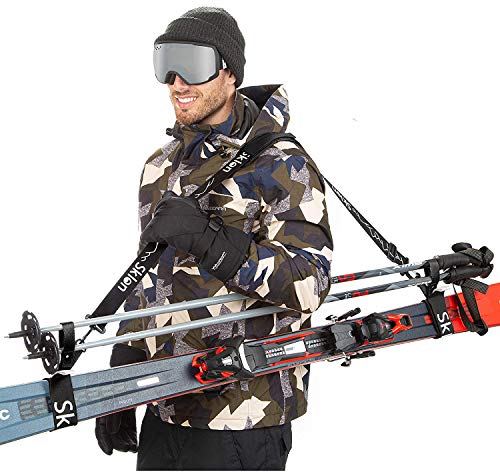
Sklon Ski Strap and Pole Carrier
- Type:
- Carry strap
- Holds:
- Skis and poles
- Use:
- Car park to lift
Fifteen dollars to stop dropping your skis in the car park. It is not glamorous and it will be used every single ski day for years.
Best for: Everyone. Especially anyone walking more than fifty yards to the lift.
What it costs you: It is a strap.

DryGuy Boot and Glove Electric Dryer
- Capacity:
- Boots plus gloves
- Heat:
- Warm air
- Timer:
- Yes
A damp liner is a cold liner, and no sock fixes it. Drying boots overnight is the highest-impact thing you can do about cold feet, and it also roughly doubles liner lifespan.
Best for: Anyone on a multi-day trip, and anyone with cold feet.
What it costs you: Never dry a liner on a radiator or with high heat. Heat damages the foam permanently.

Bosvision Retractable Combination Ski Lock
- Cable:
- 3 ft retractable
- Lock:
- 4-digit combination
- Use:
- Lunch stops
Skis walk off the rack outside the lodge. This will not stop a determined thief with tools and it will absolutely stop the opportunist who picks up the nearest unlocked pair.
Best for: Anyone leaving skis outside a lodge.
What it costs you: A thin cable is cuttable. It is a deterrent, not a vault.

CURREX EdgePro Ski Boot Insoles
- Type:
- Supportive footbed
- Arch:
- Multiple profiles
- Use:
- Ski and snowboard boots
Stock boot insoles are flat sheets of foam. A supportive footbed stops the foot spreading and rolling inside the shell, which is what causes most of the pinch, arch pain and lost edge feel people blame the boot for.
Best for: Almost every boot. The cheapest upgrade with the biggest change in feel.
What it costs you: A custom moulded footbed from a bootfitter is better. This is a large fraction of that for a small fraction of the price.

Booster Strap Intermediate Performance Ski Boot Strap
- Type:
- Elastic power strap
- Replaces:
- Stock velcro strap
- Use:
- Alpine boots
An elastic strap loads progressively instead of hitting a dead stop the way a nylon strap does, which makes a stiff boot flex smoothly and a soft boot feel more supportive. Forty-five dollars for a real change in how a boot skis.
Best for: Anyone whose boot feels either dead or vague through the flex.
What it costs you: Does not fix a boot that is the wrong size or the wrong flex.

UNIHAND Rechargeable Hand Warmers, two pack
- Runtime:
- Up to 20 hours
- Charge:
- USB rechargeable
- Count:
- Two
Rechargeable rather than disposable, so the cost is once rather than every day. They also double as a power bank, which matters when a phone dies in the cold at the worst moment.
Best for: Anyone with cold hands, and every deep-cold day.
What it costs you: Battery output drops in severe cold. Keep them in an inside pocket, not an outer one.

Athletico Rolling Double Ski Bag, 190 cm
- Length:
- 190 cm
- Capacity:
- Two pairs
- Padding:
- Padded, wheeled
Padded and wheeled, sized for two pairs. Airline handling breaks tips and tails, and a padded bag is much cheaper than a topsheet repair or a new ski.
Best for: Anyone flying to ski.
What it costs you: Bulky to store, and a 190 cm bag is oversized on some airlines. Check before you fly.

Thule Ski and Snowboard Rack Carrier
- Capacity:
- Multiple pairs
- Mount:
- Crossbar
- Lock:
- Lockable
Wet skis inside a car soak the interior and edges cut upholstery. Thule racks fit properly and lock, and a rack that does not fit properly is a rack that comes off on the highway.
Best for: Regular drives to the hill with a full car.
What it costs you: Costs fuel economy and needs crossbars you may not have. Check the fit guide for your vehicle.

KULKEA Thermal Trekker Heated Ski Boot Bag, 62 L
- Volume:
- 62 L
- Heat:
- Powered boot warming
- Carry:
- Backpack
Warm boots at the car mean a boot you can actually buckle, which matters most for the stiff boots that are hardest to get into cold. It also carries the whole kit as a backpack rather than a shoulder bag.
Best for: Cold climates, stiff boots, and long walks from the car.
What it costs you: Expensive for a bag, and needs power at the car or the hotel.
Specifications are the manufacturer's published figures, not measurements we took. Sizes, prices and stock change constantly, so confirm on the retailer page before buying. We earn commissions from Backcountry and from qualifying Amazon purchases, and every link on this page is one or the other. Where a Backcountry button reads "shop the category" it opens a search for that category rather than that exact model, so it finds comparable gear alongside it.
Travelling with ski equipment
Airline handling is hard on skis and the common damage is broken tips and tails and cracked topsheets, which cost more to repair than a padded bag costs to buy. A padded rolling bag sized for the ski is the sensible purchase for anyone who flies to ski, and boots should travel in the cabin if the airline allows it, because a lost bag is recoverable and a lost boot ends the trip.
Driving is easier on equipment and harder on the car. A roof rack keeps wet skis out of the interior and stops steel edges cutting upholstery, and it needs crossbars that actually fit the vehicle rather than approximately fit it.
Where care fits in the wider picture
Care is the cheapest way to lower the cost per day of everything you own, which is the same arithmetic that drives the renting against buying comparison and the season budget calculator. Equipment that lasts five seasons instead of three is a third cheaper without buying anything different. If you are shopping second hand, the used gear guide covers what to inspect and what should always be bought new.
Frequently asked questions
What should I do with my gear after every ski day?
Twenty minutes, and it decides how long everything lasts. Pull the liners out of your boots and dry them at room temperature or with a warm-air dryer, never with high heat. Buckle the empty shells loosely so they keep their shape. Hang outerwear open rather than leaving it stuffed in a bag. Wipe the skis dry, especially the edges, and stand them separated rather than base to base. Pull skins apart and dry them glue side out. None of it is difficult and all of it is the difference between equipment that lasts five seasons and equipment that lasts two.
Why do ski boots need drying and what temperature is safe?
A liner absorbs a substantial amount of sweat over a day and a damp liner is a cold liner, because moisture conducts heat away from your foot far faster than dry air. Drying also roughly doubles liner life, since damp foam packs out and breaks down faster. The temperature rule is absolute: warm moving air only, never a radiator, a stove, a fire or a hot boot dryer. Boot foam is heat set at the factory and high heat permanently collapses it, which converts a fit problem into a new pair of boots. If it is too hot to hold your hand against, it is too hot for a liner.
How should I store skis over the summer?
Hot wax the bases and leave the wax unscraped, which protects against the oxidation that turns a base chalky and permanently slow. Dry them completely first, especially around the edges and the binding. Store them somewhere cool, dry and out of direct sunlight, standing or lying flat but not under anything heavy, and with the bindings left at their normal setting rather than backed off. Scrape and brush the storage wax off before the first day of the following season. A garage that gets very hot in summer is the one place not to put them.
Do I need to wash my ski jacket?
Yes, and failing to is why most jackets stop working. Body oils, sunscreen and dirt clog the face fabric and kill the durable water repellent finish, and once the face fabric wets out the membrane stops moving vapour even though it remains perfectly waterproof. That clammy feeling gets blamed on breathability. Wash in a technical cleanser rather than detergent, never use fabric softener, and then tumble dry on low or press with a warm iron under a cloth to reactivate the repellent finish. Reproof with a wash-in or spray treatment when tumbling no longer restores beading.
Should I loosen my bindings for storage?
No. Backing a binding off for summer used to be common advice and it is not current practice: modern bindings are designed to sit at their setting, and the springs are not meaningfully relaxed by a few months. What actually matters is that the release value is set and verified by a certified technician on a calibrated jig, and that it is checked periodically, because the torque a binding really releases at drifts away from the number in the indicator window as it ages. Turning the screw yourself, in either direction, is the thing not to do.
What is worth checking before the first day of the season?
Scrape and brush the storage wax off the skis and check the edges for rust and burrs. Check the boot liners, buckles and power straps, and that the boots still fit, since feet change. Test your avalanche transceiver with fresh batteries and do a full function check, and check skins for tack and hardware. Reproof outerwear if it stopped beading last season. Book a binding check with a shop if it has been a year or more, so the release value is verified on a jig rather than assumed. Doing all of that in autumn rather than at the trailhead is the entire point.
How we choose: we compare published manufacturer specifications, published certification standards and verified owner reviews across retailers. We do not test equipment in person, and every figure quoted here is the manufacturer's published number unless we say otherwise. This is researched buying guidance and not professional instruction: binding release values are set by a certified technician on a calibrated jig, and avalanche terrain requires formal training and a current regional forecast that no article can replace.