Buying used ski gear without buying a problem
Skis, poles and outerwear are safe to buy used with inspection. Boots are a fit problem rather than a safety one and are usually a poor buy. Bindings need checking against the manufacturer's indemnified list before purchase, or no shop will set a release value. Helmets and avalanche transceivers should always be bought new.
The used market in skiing is deep, seasonal and full of genuine bargains, and it also contains a few specific traps that turn a saving into a write-off. This page splits the categories into what is safe, what needs a check, and what should always be new.
The short version
| Item | Buy used? | The catch |
|---|---|---|
| Skis and boards | Yes | Check base flatness, edges, delamination and previous mount holes |
| Poles | Yes | Check for bends and cracked lower sections. Cheap enough that it rarely matters |
| Outerwear | Yes | Check taped seams, zips and whether it still beads. Often just needs washing |
| Bindings | With a check | Must still be on the manufacturer's indemnified list or no shop will touch it |
| Boots | Rarely | The liner is moulded to somebody else. Consider shell plus new liner |
| Skins | With caution | Glue is a consumable. Budget for a reglue and check the plush at tip and tail |
| Probes and shovels | Yes | Check the cable tension and the shaft lock. Simple mechanical items |
| Helmets | Never | Impact damage is invisible and the liner crushes once |
| Transceivers | Never | Service life, invisible degradation, no recovery from a failure |
The two absolute exclusions
Helmets. A helmet works by having its expanded polystyrene liner crush under impact, absorbing energy. It crushes once. A helmet that has taken a hard hit may be structurally spent with no visible damage at all, and there is no inspection that reveals it. Buying used means trusting a stranger's account of every crash the helmet has been in, and people forget or minimise. It is also one of the cheapest items in a ski kit.
Avalanche transceivers. A transceiver has a service life, manufacturers specify inspection intervals, and its transmit and receive performance can degrade with age in ways that are not visible or obvious. It is also the item where a failure has no recovery path, since the entire premise of companion rescue is that the device works when it is needed. Add that older units may be single or dual antenna, which is a genuine performance gap against a modern three antenna device, and the case closes.
Neither of those is about the used market being untrustworthy. It is that these two items have failure modes you cannot inspect for and consequences you cannot absorb. Avalanche gear only works alongside formal training and never substitutes for an avalanche course, and starting that system with a device of unknown history is the wrong place to save money.
Transceivers, one per person, bought new

BCA Tracker S Avalanche Transceiver
- Antennas:
- Three
- Range:
- About 50 m
- Interface:
- Real-time display
Three antennas, a real-time display, and almost nothing to get wrong under stress. Beacon searching is a skill performed at the worst moment of your life, and the beacon that helps most is the one whose interface never surprises you.
Best for: A first beacon, and the sensible default for a recreational tourer.
What it costs you: Fewer marking and group-check features than the top models. Practise more instead of buying more.

Black Diamond Recon X Avalanche Transceiver
- Antennas:
- Three
- Marking:
- Multiple burial
- Updates:
- Bluetooth firmware
Multiple-burial marking matters in exactly one scenario and it is the scenario that kills groups: two people buried and a searcher unable to separate the signals. Bluetooth firmware updates keep the unit current instead of obsolete.
Best for: A tourer who travels in larger groups and practises multiple burials.
What it costs you: More interface to learn. An unpractised searcher on a complicated beacon is slower than a practised one on a simple beacon.

BCA Tracker 3 Avalanche Transceiver
- Antennas:
- Three
- Profile:
- Slim
- Signal suppression:
- Yes
The slim body genuinely changes whether you wear it on your body rather than stuffing it in a pack, and a beacon in a pack that is torn off you in a slide is a beacon that is not on you.
Best for: Anyone who has been tempted to leave a bulkier beacon in a pocket.
What it costs you: Costs more than the Tracker S for a difference most users will not exploit.

BCA T4 Turbo Avalanche Beacon Rescue Package
- Includes:
- Transceiver, probe, shovel
- Antennas:
- Three
- Use:
- Complete kit
All three items from one maker, sized to work together, with no chance of buying a beacon and then discovering the probe you already own is 200 cm. Buying the kit is how most people should buy this.
Best for: A first complete avalanche kit, bought all at once as it should be.
What it costs you: The bundled shovel and probe are competent rather than best in class. And the kit is not the expensive part of getting into the backcountry: the course is, and the course comes first.
Specifications are the manufacturer's published figures, not measurements we took. Sizes, prices and stock change constantly, so confirm on the retailer page before buying. We earn commissions from Backcountry and from qualifying Amazon purchases, and every link on this page is one or the other. Where a Backcountry button reads "shop the category" it opens a search for that category rather than that exact model, so it finds comparable gear alongside it.
Inspecting used skis
- Sight down the base from the tail. It should be flat. A concave base grabs and a convex base wanders, and both need a stone grind to fix.
- Run a thumb along both edges, gently. Feel for burrs, cracks, and sections filed so thin that there is no steel left to work with.
- Look for core shots. Gouges through the base into the material below let water into the core and are a real problem rather than a cosmetic one.
- Check the tip and tail for delamination. Any lifting of the topsheet from the core, or a soft or crunchy feeling when you flex it, is terminal.
- Count the mount holes. Each set of plugged holes reduces what a future mount can do. Three sets is close to the end of a ski's useful life.
- Flex both skis against each other. They should feel the same. A pair where one is noticeably softer has one dead ski.
Bindings and the indemnified list
This is the trap that catches people out and it has nothing to do with condition. Every season each manufacturer publishes an indemnified list, which is the set of binding models a shop is authorised to mount, adjust and test. A binding that has aged off that list will be refused by most shops.
The consequence is that you own a binding nobody will set a release value on, which means it cannot be legitimately adjusted to your boot and cannot be tested. Check the model against the current list before buying, and treat anything more than roughly ten years old as suspect.
Used boots, and the shell plus liner route
Boots are the item people are most tempted by and the one where the saving is least real, because a liner packs out into the shape of the previous owner foot. A used boot is a boot moulded to somebody else, and the packing out that is supposed to happen for you has already been spent.
There is a legitimate route: buy the shell used and fit a new liner. Shell fit is what actually matters and it is checkable. Pull the liner out, put your foot in the bare shell with your toes touching the front, and measure the space behind your heel: roughly one to one and a half fingers is a performance fit and two fingers is comfortable. If the shell size is right, a new liner turns it into a boot fitted to you.
Also check the shell and cuff for cracks, particularly around buckle rivets, check that the buckles and power strap are intact and adjustable, and check whether the sole is worn past its wear indicators, because a worn sole changes how the binding grips and releases. The boot fitting guide covers the shell fit test in detail and the mondopoint calculator converts your foot length into the only boot size that means anything.
Ski boots, at three budgets

Nordica The Cruise Mens All-Mountain Boots, 31.5 mondo
- Flex:
- About 70
- Last:
- Wide, comfort fit
- Size:
- 31.5 mondo
A soft flex and a generous last. This is the boot for someone whose first four ski days were ruined by rental boots, and comfort is not a compromise for a new skier: a boot you can stand in is a boot you will ski in all day.
Best for: A first pair, a wide foot, and green to blue terrain.
What it costs you: Too soft to drive a stiff ski, and it will feel vague as soon as you start skiing quickly. Note the size: boots are sold per size and this listing is one shell.
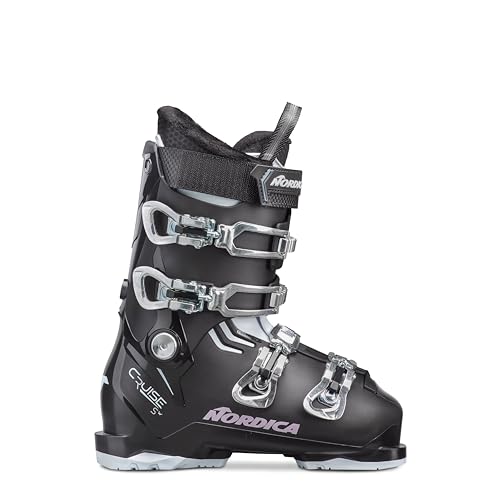
Nordica Cruise S W Womens All-Mountain Boots, 24.5 mondo
- Flex:
- About 65
- Last:
- Wide, comfort fit
- Size:
- 24.5 mondo
A lower cuff height and a softer flex, which are the two changes that genuinely matter in a womens boot and are not marketing. A cuff that is too tall bruises the shin and stops the skier bending the boot at all.
Best for: A newer skier with a wide foot, or anyone who has been fighting a shin bang.
What it costs you: Soft. It will not hold up under an advanced skier.

Rossignol Kelia 50 Womens Ski Boots
- Flex:
- 50
- Last:
- 104 mm, wide
- Level:
- Beginner
A very soft flex and a 104 mm last, which together make the easiest boot on this page to get into and to stand in. For a skier still learning, that is worth more than any performance claim.
Best for: A genuine beginner, and a wide or high-volume foot.
What it costs you: A 50 flex is the softest end of the market. Fast skiing will overwhelm it immediately.

Atomic Hawx Prime 100 Mens Ski Boots, 28/28.5 mondo
- Flex:
- 100
- Last:
- 100 mm, medium
- Shell:
- Heat mouldable
A 100 flex on a 100 mm last is the exact centre of the ski boot market, and it is the centre for a good reason: it fits the most feet and suits the most skiers. The shell is fully heat mouldable, so a bootfitter has real room to work.
Best for: An intermediate to advanced skier with an average-width foot, buying a boot to keep.
What it costs you: A 100 mm last is too narrow for a genuinely wide foot and no amount of punching fixes the wrong last.

Atomic Hawx Magna 100 Mens Ski Boots, 28/28.5 mondo
- Flex:
- 100
- Last:
- 102 mm, wide
- Shell:
- Heat mouldable
The same boot on a 102 mm last. This is the entry that solves the most real problems on this page, because a wide-footed skier is usually offered either a wide comfort boot with no performance or a performance boot that hurts, and this is neither.
Best for: A wide or high-volume foot that still wants a 100 flex.
What it costs you: A wider last gives up a little precision. A narrow foot will swim in it.

Head Edge 65 W HV Womens Ski Boots, 25.5 mondo
- Flex:
- 65
- Last:
- High volume
- Size:
- 25.5 mondo
A high-volume shell, which is the specification a lot of women get pushed past because the marketing assumes a narrow foot. Volume and width are not the same thing, and a high instep needs volume.
Best for: A womens fit with a high instep or a wide forefoot, skiing blues.
What it costs you: A 65 flex sits between beginner and intermediate. Strong skiers will want more.

Nordica Sportmachine 3 80 Mens Ski Boots, 29.5 mondo
- Flex:
- 80
- Last:
- 102 mm
- Liner:
- Heat mouldable
An 80 flex on a 102 mm last with a mouldable liner. That combination is the honest sweet spot for a skier who is past beginner and not yet aggressive, and it costs meaningfully less than a 100 flex boot.
Best for: A progressing intermediate who does not want to buy twice but is not skiing hard yet.
What it costs you: You will feel the flex limit if you keep improving. That is the trade for the price.

Atomic Hawx Magna 110 S Mens Ski Boots, 27/27.5 mondo
- Flex:
- 110
- Last:
- 102 mm, wide
- Shell:
- Heat mouldable
A genuinely stiff boot on a wide last, which is a combination the market barely offers. Most 110 and above boots are built on 98 to 100 mm shells, and a wide-footed advanced skier is usually left choosing between pain and vagueness.
Best for: An advanced skier with a wide foot who skis fast.
What it costs you: A 110 flex in a cold parking lot is genuinely hard to get into, and if you cannot bend a boot you cannot steer with it. Do not buy stiffness you cannot use.
Specifications are the manufacturer's published figures, not measurements we took. Sizes, prices and stock change constantly, so confirm on the retailer page before buying. We earn commissions from Backcountry and from qualifying Amazon purchases, and every link on this page is one or the other. Where a Backcountry button reads "shop the category" it opens a search for that category rather than that exact model, so it finds comparable gear alongside it.
Outerwear, which is the best used category
Technical outerwear is the easiest thing to buy second hand, because the failure modes are visible and most of what looks like failure is dirt. Check the taped seams on the inside for lifting or peeling, check the zips run smoothly including the storm flap, and check for delamination on a two-layer garment, which shows as blistering of the inner face.
A jacket that no longer beads water has almost always not failed. It is clogged with body oils and sunscreen, and a wash in a technical cleanser plus a low tumble to reactivate the finish usually restores it. That makes a used shell that looks tired a genuine bargain rather than a risk. The gear care guide covers washing and reproofing.
Skins and touring equipment
Used skins are a reasonable buy provided you budget for a reglue, because glue is a consumable that fails long before the plush does. Check the plush at the tip and tail, which is where wear shows first, and check the tip loops and tail clips for perishing and bending. Also check the width against the tip of your specific ski, since a skin sized for a narrower ski leaves the shovel bare.
Probes and shovels are simple mechanical items and are fine used. Check the probe cable tension and that it assembles crisply, and check the shovel shaft lock engages positively. Both are cheap enough that a doubtful one is not worth the saving. The skin care and glue repair guide covers reglueing.
Where and when to buy
- Spring. Ski swaps, end of season clearances and people upgrading. The market is flooded and prices are lowest.
- Shop ex-demo and ex-rental. Maintained on a schedule, and the shop will usually mount and adjust it, which solves the binding question.
- From people upgrading rather than clearing out. Better maintained, and they can answer questions about history.
- Locally, in person. Everything on this page requires handling the item. Photographs do not show a concave base or a soft ski.
- With the shop visit priced in. A used ski at $200 plus a $100 mount is a $300 ski without a warranty.
That last point is the one that decides a surprising number of these purchases. Once you add mounting, a new liner or a reglue, used equipment often lands close to the price of new entry-level equipment with a warranty. The first resort setup prices a complete new kit with a running total, which is the number worth comparing against, and the buying order guide covers what to buy first either way.
Frequently asked questions
What should never be bought used?
A helmet and an avalanche transceiver, without exception. A helmet liner absorbs impact by crushing and it crushes once, so a helmet that has taken a hard hit can be structurally spent with no visible sign and no way to inspect for it. You are trusting a stranger account of crashes that may not be mentioned. A transceiver has a service life, its performance can degrade with age in ways you cannot see, and it is the item where a failure has no recovery path. Both are also the two cheapest items in a kit relative to what they do, which makes the saving a poor trade.
Is it safe to buy used ski bindings?
Only with a specific check first, and the check is not about condition. Manufacturers publish an indemnified list each season, which is the set of models a shop is authorised to mount, adjust and test on a jig. A binding that has aged off that list will be refused by most shops, which leaves you owning a binding nobody will set a release value on. Before buying used bindings, or a used ski with bindings on it, look up whether the model is still indemnified, and assume anything more than about ten years old is not.
How do I inspect used skis?
Sight down the base from the tail to check it is flat rather than concave or convex, run a thumb along both edges feeling for burrs, cracks and sections where the edge has been filed to nothing, and look for delamination at the tip and tail where the topsheet lifts from the core. Check for previous mount holes, because each set reduces what a future mount can do and a ski with three sets is near the end of its useful life. Look for core shots, meaning gouges through the base to the material underneath, which let water into the core and are a genuine problem.
Are used ski boots a good idea?
Rarely, and the reason is fit rather than safety. A liner packs out into the shape of the previous owner foot, so a used boot is a boot moulded to somebody else. The shell itself can be sound, so a used boot with a new liner is a legitimate route if the shell size is right for you, and shell fit is measured by removing the liner and checking the space behind your heel with your toes at the front. Also check for cracked shells and cuffs around the buckle rivets, and check whether the sole is worn past the wear indicators, since a worn sole affects how the binding releases.
What is the best time and place to buy used?
Spring, from ski swaps and end of season shop clearances, and from people who are upgrading rather than clearing out a garage. Spring is when the market is flooded and prices are lowest, and buying then for the following season is the cheapest way to own good equipment. Shop clearances of ex-demo and ex-rental gear are worth a look because the equipment has been maintained on a schedule and the shop will usually mount and adjust it, which solves the binding indemnification question at the same time.
How much should used gear cost?
As a rough guide, expect roughly half of retail for equipment one to two seasons old in good condition, roughly a third for three to five seasons, and very little beyond that regardless of appearance. Adjust down for mount holes in skis, for boots without a matching liner and for anything that needs a shop visit before use. Remember to add the cost of that shop visit into the comparison: a used ski at two hundred dollars plus a hundred dollar mount is a three hundred dollar ski, which is close to what a new system ski costs with a warranty.
How we choose: we compare published manufacturer specifications, published certification standards and verified owner reviews across retailers. We do not test equipment in person, and every figure quoted here is the manufacturer's published number unless we say otherwise. This is researched buying guidance and not professional instruction: binding release values are set by a certified technician on a calibrated jig, and avalanche terrain requires formal training and a current regional forecast that no article can replace.