Down vs synthetic insulation for skiing
Synthetic insulation is the right choice for anything worn while skiing. Down has far better warmth per gram but insulates by lofting, and loft collapses when wet, while skiing is wet from melting snow outside and sweat inside. Down still belongs in a ski kit as the jacket you put on after skiing, dry and standing still.
Down is the better insulator by every measure except the one that matters here. It is warmer per gram, packs smaller and lasts longer with care. It also stops working almost completely when it gets wet, and snow sports is a wet activity from two directions at once. That single fact settles the question for anything worn on the hill, and the interesting part of the comparison is where the exceptions are.
The comparison in one table
| Down | Synthetic | |
|---|---|---|
| Warmth per gram | Best available. Nothing is close | Heavier for equivalent warmth |
| Wet performance | Loft collapses. Insulating value near zero | Loses a fraction and keeps working |
| Drying time | Hours, and needs tumbling to reloft | Fast, often from body heat alone |
| Packed size | Smallest | Bulkier, though the gap has narrowed |
| Wearable while working | No. Too warm and it soaks from inside | Yes, particularly air permeable constructions |
| Cost for equivalent warmth | Higher | Lower, and cheaper to repair |
| Lifespan with care | Very long. A good down jacket lasts decades | Shorter. Fibres break down with compression |
| Right for skiing? | After skiing, in a hut, in a duffel | Yes, for anything worn on the hill |
Why loft is the whole mechanism
Insulation does not generate heat. It traps a layer of still air, and still air is a poor conductor, so your body warms it and the layer slows the rate at which that warmth leaves. The material itself is almost irrelevant except as a scaffold for holding air in place.
A down cluster is an extraordinarily efficient scaffold: a three dimensional structure of fine filaments that holds a large volume of air for very little mass. It also depends entirely on those clusters staying dry and separate. Add water and surface tension pulls the filaments together into a dense clump, the air volume disappears, and the garment becomes a heavy layer of wet feathers with almost no insulating value.
Synthetic insulation uses fibres that are individually stiff enough to hold their arrangement whether wet or dry. It is a less efficient scaffold, which is why it weighs more for the same warmth, and it is a far more robust one.
Skiing is wet from both sides
The outside is obvious: snow lands on you, sits on you, and melts. A shell handles most of that, which is why a shell is worn over insulation rather than under it.
The inside is the one that catches people out. You produce a substantial amount of water vapour while skiing and a great deal more while climbing, and some of it condenses inside your clothing as it moves outward through a temperature gradient. That means the insulating layer inside a shell gets damp over a day whatever the weather is doing, and a down midlayer inside a shell is slowly being wetted from the inside all day.
Insulation picks for skiing
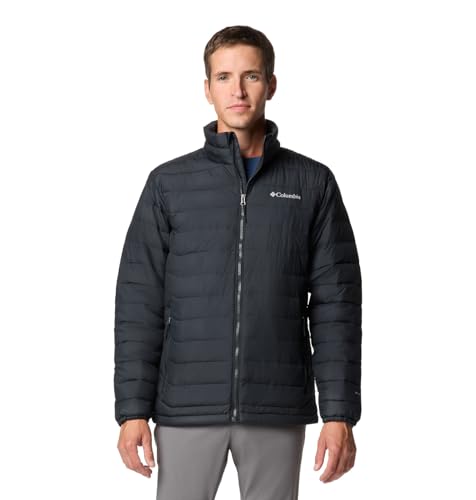
Columbia Mens Powder Lite II Insulated Jacket
- Insulation:
- Synthetic
- Use:
- Midlayer or standalone
- Face:
- Water resistant
Synthetic insulation keeps most of its warmth wet, which is the correct choice for skiing where down is not. This works as a midlayer under a shell and as a jacket on its own in the car park.
Best for: A first midlayer, and cold resort days.
What it costs you: Bulkier and heavier than down for the same warmth, and not very breathable if you are working.
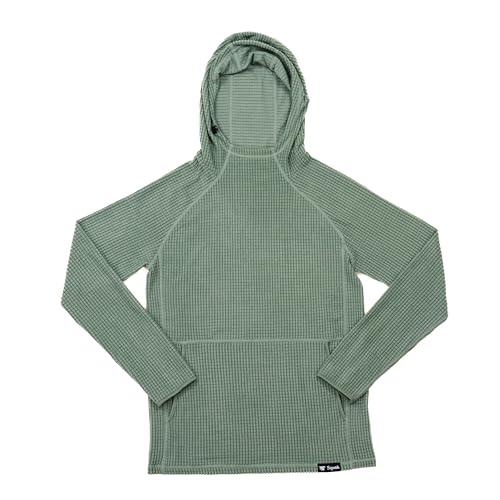
Squak Mountain Co. Microgrid Fleece Hoodie
- Fabric:
- Grid fleece
- Weight:
- Light
- Use:
- Midlayer
Grid fleece is the single most useful layer in snow sports. The grid traps air in the squares and moves moisture along the channels, so it insulates while you are working instead of soaking through the way a solid fleece does.
Best for: Everyone. Resort midlayer and the layer a tourer climbs in.
What it costs you: Not windproof and not warm on its own when you stop. It is a system component.

Marmot Airfleece Mens Full-Zip Midlayer Hoody
- Fabric:
- Air-permeable fleece
- Fit:
- Layering
- Use:
- Cold resort, touring
Air permeability is the specification behind the phrase "breathable": a fleece that lets air through dumps heat when you are climbing and traps it when you zip a shell over it. That is one garment doing two jobs.
Best for: Cold days and high-output touring.
What it costs you: Pricey for a fleece, and warmer than you want on a mild day.
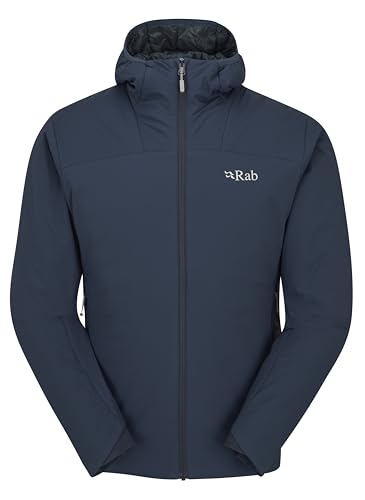
Rab Mens Xenair Alpine Light Hooded Insulated Jacket
- Insulation:
- Synthetic, air permeable
- Face:
- Wind resistant
- Use:
- Transitions and belays
The jacket that lives in a touring pack and comes out at every transition. Air-permeable synthetic insulation can be worn while moving in deep cold without becoming a sauna, which down cannot do.
Best for: Touring transitions, cold summits, and standing around in the wind.
What it costs you: Expensive for a layer you spend most of the day carrying. That is exactly what it is for.
Specifications are the manufacturer's published figures, not measurements we took. Sizes, prices and stock change constantly, so confirm on the retailer page before buying. We earn commissions from Backcountry and from qualifying Amazon purchases, and every link on this page is one or the other. Where a Backcountry button reads "shop the category" it opens a search for that category rather than that exact model, so it finds comparable gear alongside it.
Fill power, and how to compare jackets honestly
Fill power is the volume in cubic inches that an ounce of down occupies when lofting freely. So 850 fill down is more efficient than 650 fill down: more air trapped per unit of mass. It is a measure of quality, not of warmth.
The number that determines how warm a jacket is is the fill weight, meaning how many grams of down are actually in it, multiplied by the efficiency of that down. A jacket with 200 g of 650 fill is warmer than one with 80 g of 850 fill, and it is also heavier. Manufacturers reliably publish fill power because it sounds impressive and inconsistently publish fill weight, which is why comparing two down jackets on paper is harder than it looks.
Synthetic insulation is quoted in grams per square metre of the insulation sheet, which is more directly comparable: 60 g/m2 is a light active-insulation weight, 100 g/m2 is a substantial midlayer, and 133 g/m2 and up is a warm static piece.
Air permeable synthetic, and why touring cares
The important recent development is insulation designed to let air through rather than block it. A conventional puffy has a tightly woven face fabric, which makes it a wind layer with insulation inside: excellent standing still, unbearable within ten minutes of climbing.
An air permeable piece breathes enough to be worn while working, so it stays on through the first minutes of a climb, comes off when you warm up, and goes back on over everything at the transition. That flexibility is what a touring day actually requires, and it is not something down can do at any price because down needs a tight face fabric to stop the clusters migrating.
The same principle, applied elsewhere in the kit
Once you accept that wet performance beats warmth per gram in snow sports, several other choices resolve automatically. Gloves and mittens should be synthetic, because hands get wet and a down-filled mitten that has gone flat is a wet rag. Ski pants should never be down filled. And the layer against your skin should be merino or a merino blend, for a related reason: wool keeps insulating when damp, which the base layer comparison covers in full.
Gloves and socks, same principle
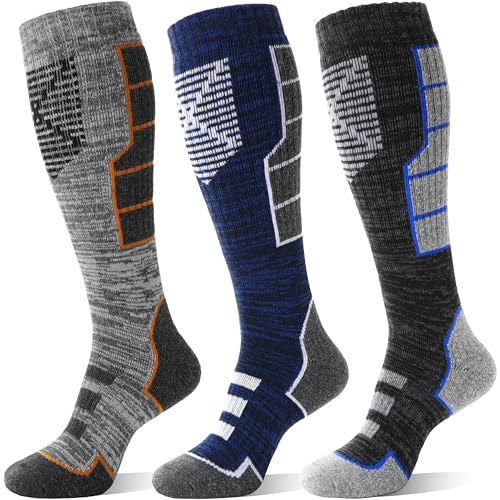
Anlisim Merino Wool Ski Socks, three pairs
- Fabric:
- Merino blend
- Height:
- Over the calf
- Count:
- Three pairs
Three pairs for the price of one name-brand pair. The rule that matters more than the brand: ONE thin sock, never two and never a thick one. Volume in a ski boot cuts circulation and cold feet come from a tight boot, not a thin sock.
Best for: Anyone still wearing two pairs of cotton socks in ski boots.
What it costs you: Less durable and less precisely cushioned than a purpose-built ski sock.

Hylaea Merino Wool Ski Socks
- Fabric:
- Merino blend
- Cushion:
- Targeted shin and shin
- Height:
- Knee high
Targeted cushioning over the shin and none across the instep, which is what a ski sock is for. A hiking sock in a ski boot bunches exactly where the boot needs to grip.
Best for: Full days in a properly fitted boot.
What it costs you: Nothing fixes a badly fitted boot. Buy the bootfit first.

Carhartt Mens Waterproof Insulated Knit Cuff Glove
- Insulation:
- Synthetic
- Waterproof:
- Insert
- Cuff:
- Knit
A genuinely waterproof insert at a work-glove price. Most cheap ski gloves are water resistant, which means wet hands by lunchtime on a warm day.
Best for: Cold-to-moderate resort days, and anyone hard on gloves.
What it costs you: A knit cuff lets snow in on a deep day. Not a powder glove.

Minus33 Merino Wool Glove Liners
- Fabric:
- Merino wool
- Use:
- Under gloves or alone
- Weight:
- Liner weight
Twenty dollars that lets you take the outer glove off to work a buckle, a binding or a beacon without putting a bare hand on cold metal. On a transition in a wind that matters more than the outer glove does.
Best for: Touring transitions, and anyone whose hands go numb the moment a glove comes off.
What it costs you: Not warm on their own below freezing, and they soak through fast when handling snow.
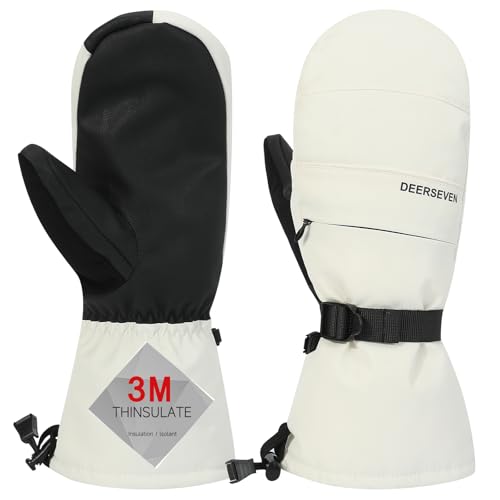
OMECHY Insulated Waterproof Ski Mittens
- Type:
- Mitten
- Insulation:
- Synthetic, heavy
- Cuff:
- Long gauntlet
Mittens are warmer than gloves and it is not close: fingers share heat instead of each radiating alone. If your hands go numb every cold day, this is the fix, and it costs less than heated gloves.
Best for: Deep cold, and anyone with poor circulation in the hands.
What it costs you: You lose dexterity, which matters for buckles, zips and anything to do with a rescue.
Specifications are the manufacturer's published figures, not measurements we took. Sizes, prices and stock change constantly, so confirm on the retailer page before buying. We earn commissions from Backcountry and from qualifying Amazon purchases, and every link on this page is one or the other. Where a Backcountry button reads "shop the category" it opens a search for that category rather than that exact model, so it finds comparable gear alongside it.
Where down still earns its place
- After skiing. Dry, standing still, in the cold. This is what down is for.
- Hut trips and overnights. Packs to nothing, warm at rest, worn indoors and in a bag.
- Travel. A down jacket compresses smaller than anything else of equivalent warmth.
- Very cold, very dry climates. Where the ambient humidity is low enough that a jacket genuinely stays dry.
- As a spare in the car. The layer that goes on the moment the boots come off.
None of those is a layer worn while skiing, which is the honest summary of the whole page.
What to buy
If you buy one insulating layer, buy a grid fleece, because it is the piece you can move in and it works across the widest range of days. If you buy two, add a thin synthetic puffy for stops and transitions. That combination under a shell is the system the shell against insulated jacket comparison argues for, and it covers roughly a forty degree range.
Frequently asked questions
Why is down a bad choice for skiing?
Down insulates by lofting, meaning the clusters trap air in the space they occupy. Loft is entirely dependent on the clusters staying dry and separate. When down gets wet the clusters clump together, the loft collapses, and the insulating value drops to almost nothing while the garment gains a lot of weight. Skiing is wet from two directions simultaneously: snow melting on the outside and sweat arriving from the inside. Synthetic insulation is made of fibres that hold their structure regardless, so it loses a fraction of its warmth wet and keeps working. That single difference decides the question for anything worn on the hill.
Does hydrophobic down solve the problem?
It reduces it rather than solving it. Hydrophobic down is treated to resist water uptake, so it takes longer to wet out and dries faster than untreated down, which is a genuine improvement for a jacket that might get damp. What it does not do is change the fundamental mechanism: once the clusters are wet enough to clump, the loft is gone in the same way. It also does nothing about the internal moisture problem, which is the one that actually affects a skier, since you sweat into a jacket from the inside all day. Treat it as a useful margin rather than a licence to ski in down.
What does fill power actually mean?
Fill power measures the volume in cubic inches that one ounce of down occupies when it is allowed to loft freely, so 850 fill down takes up more space per ounce than 650 fill down. Higher fill power means more warmth per gram, which matters when weight and packed size are the constraint. It does not mean warmer in absolute terms: a jacket with a lot of 650 fill can be warmer than one with a little 850 fill. The number to compare between jackets is the fill weight in grams alongside the fill power, and manufacturers do not always publish both.
Is synthetic insulation heavier?
Yes, meaningfully. For equivalent warmth, synthetic insulation is heavier and bulkier than good down, and there is no serious argument otherwise. Modern continuous-filament synthetics have narrowed the gap and the best of them are impressively light, but down still wins on warmth per gram and on packed size. That is why down persists in mountaineering and expedition use where the garment lives in a pack and is worn dry, and why synthetic wins in ski touring where it is worn damp at every transition. Choose by the conditions the garment will actually see.
What about air permeable synthetic insulation?
This is the category worth understanding for touring specifically. Conventional insulated jackets use a tightly woven face fabric that blocks air, which makes them warm standing still and unwearable while working. Air permeable pieces are built so air moves through the fabric and the insulation, so heat and vapour escape when you are climbing and are retained when you stop or zip a shell over the top. That means you can leave the jacket on for the first minutes of a climb or a descent without cooking, which is exactly what a transition demands and what down cannot do at all.
Where does down still belong in a ski kit?
In the car, in the lodge, in a hut, and in a duffel for a trip. A warm down jacket is the best thing to put on after skiing when you are dry and standing still in the cold, and it packs into almost nothing for travel. It is also excellent as a sleeping-bag equivalent on a hut trip. What it should not be is the insulating layer inside your ski clothing, or the jacket you pull on at a windy transition over a shell you have been sweating into for ninety minutes.
How we choose: we compare published manufacturer specifications, published certification standards and verified owner reviews across retailers. We do not test equipment in person, and every figure quoted here is the manufacturer's published number unless we say otherwise. This is researched buying guidance and not professional instruction: binding release values are set by a certified technician on a calibrated jig, and avalanche terrain requires formal training and a current regional forecast that no article can replace.